CLAM BAY
This 570 acre estuary systemwas deeded
to Collier County by the developer in the
late 80’s, and together with the County,
the Pelican Bay Services Division over-
sees its health. Every year reports are
prepared assessing the health of the
system including: a bathymetric monitor-
ing report, water quality report, and a
biological\
ecological report.
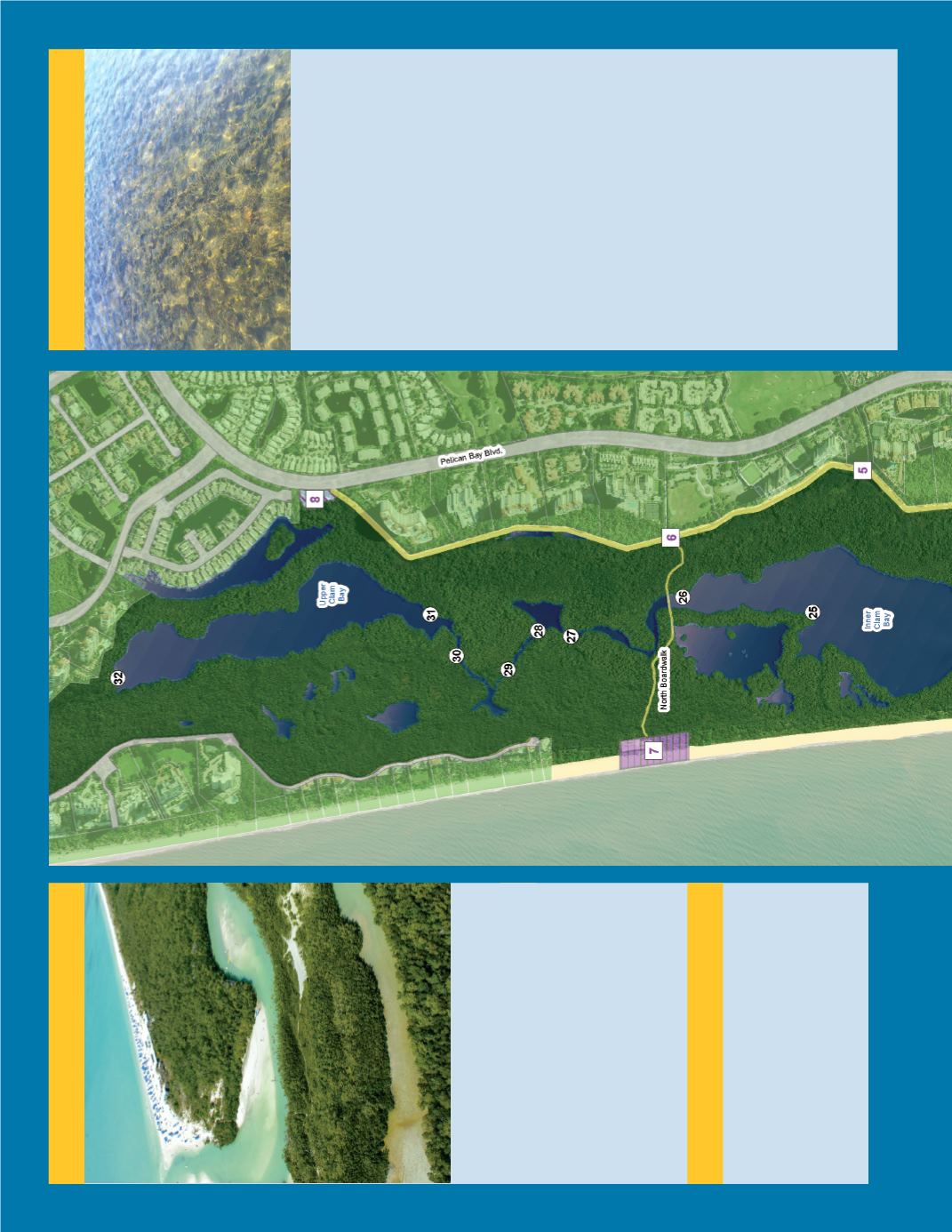
There are 32 total canoe trail makers.
The distance fromMarker #1 to Clam Pass
is approximately 1 mile (one way). The
distance fromMarker #1 to Marker #32 is
approximately 3 miles (one way).
In the channel south of Clam Pass,
sea grasses bind the substrate and
provide a rich, productive and safe
nursery area for young marine animals.
Three important species are found in
the Clam Bay system: Shoal Grass
(Halodule wrightii) with small, flat
strap-like leaves; Turtle grass (Thalas-
sia testudinum) with large strap-like
leaves, found in deeper water; and
Paddle Grass (Halophila decipiens)
with paired oval leaves. These fragile
and light-dependent true grasses are
sensitive to water quality and physical
disturbance. All boat traffic must stay
close to the marked trail. Florida’s once
abundant grass meadows have been
badly impacted by prop scarring and
degraded water quality. Please also try
not to wade in the grass areas.
SEAGRASSES
DISTANCEINFORMATION


