MUDFLATS
Submerged open areas of mud and
sand are common in estuaries and are
often marked at low tide by wading
birds picking through the rich inver-
tebrate inhabitants. Shellfish crawl
on the surface or lie buried within the
mud, poking out their siphons to filter
seawater for food and oxygen. Worms
build protective tubes and filter small
food particles or crawl through the sedi-
ment hunting for even smaller creatures
to eat. Look out for:
• Florida fighting conch
• Mudsnails on the surface
• Shells of the tellin or angel wing,
buried in the mud
• Parchment tube (a white
papery tube)
• Sand mason worms (tiny pieces
of cemented sand) peeking out
of the surface
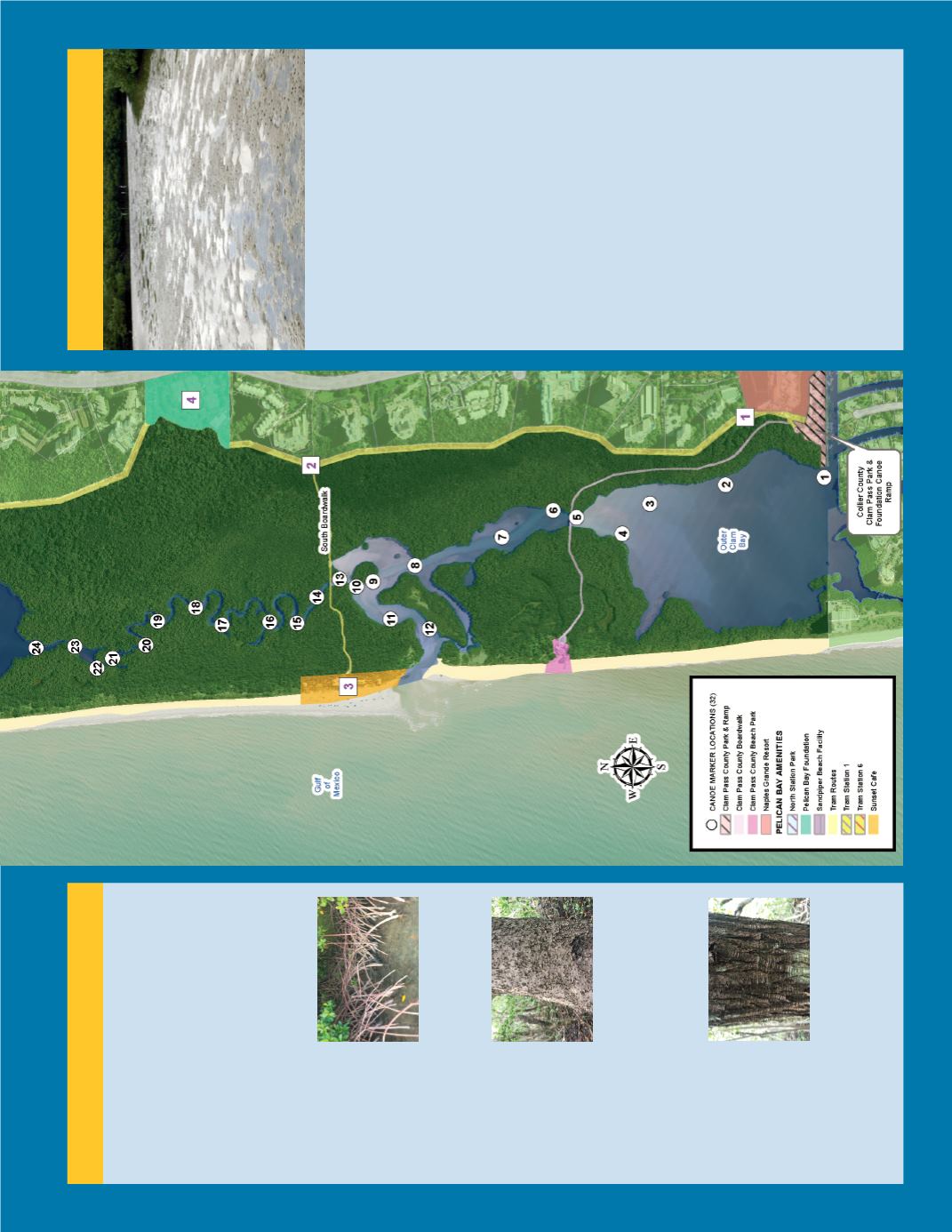
Three species of these salt tolerant trees
are found in coastal Florida. Mangroves
protect the coast from storms and erosion,
provide rich feeding ground and nursery
areas for marine animals and are the start-
ing point in highly productive estuarine
ecosystems. Because of their importance
they are a legally protected species.
The red mangrove (Rhizophora mangle)
grows closest to
the waterways and
has a tangle of
supporting prop
roots, shiny dark
green leaves and
distinctive propagules (seeds).
Black mangroves (Avicennia germinans)
have leaves with
silvery undersides,
straight trunks
and pnemato-
phores, which are
like underground
snorkels sucking in air to cope with the
low oxygen soil.
White mangroves (Laguncularia
racemosa) possess slightly rounded, pale
green leaves with
characteristic nod-
ules on the stem
that excrete salt.
Also associated
with mangrove
systems is the buttonwood (Conocarpus
erectus) in dryer areas.
MANGROVES


