M
ost people who live in Pelican
Bay are probably familiar
with several of the numerous
species of reptiles that also live in Peli-
can Bay. The alligator is probably the
best known reptile here and one which
most residents have seen. If you walk
the berm very often, you have likely
seen a Florida softshell turtle swimming
in the water near the berm. You may
have spotted a Peninsular cooter turtle
out basking in the sun on the bank near
the berm. Although most residents have
never actually seen one, they probably
know that the Loggerhead Sea turtles
use our beaches each summer to lay
their eggs. Only those residents who
go to the beach fairly often are likely
to have encountered a gopher tortoise.
Pelican Bay is home to an unknown
number of gopher tortoises.
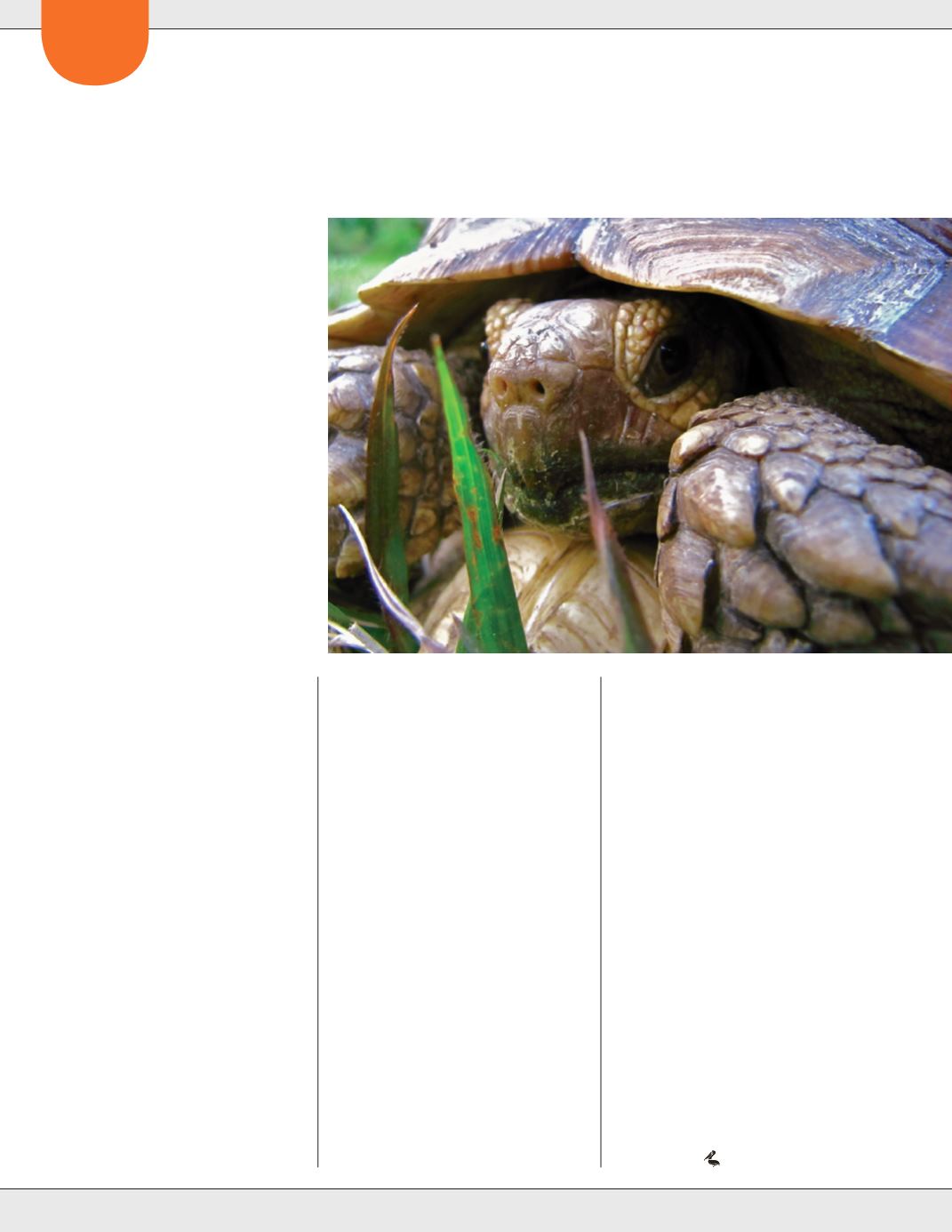
The gopher tortoise (Gopherus
polyphemus) is considered a threat-
ened species in the state of Florida.
The gopher tortoise is a fairly large
land turtle. The adults have an
average weight of about 9 pounds.
Gopher tortoises belong to a group
of land tortoises that were found in
western North America more than 60
million years ago and are considered
a keystone species because they pro-
vide support for a large number of
plants and animals in the community
in which they live. Gopher tortoises
are great diggers. They make under-
ground burrows for their home.
These burrows are 35 to 50 feet in
length and are known to provide
shelter for more than 350 different
species of animals. Some of the
animals known to use burrows are
snakes, lizards, rats, birds, rabbits,
burrowing owls and many others.
Gopher tortoises mainly eat plants,
which they locate by sight and smell.
They are known to eat more than 300
species of plants. They feed on grasses,
flowers, mushrooms, fruits, etc. I have
even seen them eating poison ivy.
Gopher tortoises usually get enough
water from the food they eat and
normally don’t need to drink water.
The gopher tortoise reaches sexual
maturity at about 10 to 15 years of
age. During the mating season, which is
between April and November, females
lay their eggs in their burrow. They lay
from one to 25 eggs, which incubate
underground for about 80 to 90 days.
The sex of the young is determined by
temperature, with females resulting
from warmer eggs and males from
cooler eggs.
A number of species prey upon
baby gopher tortoises and gopher
tortoise eggs, including raccoons,
snakes, feral cats, dogs, armadillos,
foxes, skunks and alligators. Humans
have eaten gopher tortoises for
thousands of years. During the
Great Depression, gopher tortoise
was known as the “Hoover Chicken”
because they were eaten by poor
people. Today it is illegal to kill a
gopher tortoise in the United States.
Gopher tortoises have long lives and
there are reports of them living to
more than age 70. Probably the best
place to look for a gopher tortoise in
Pelican Bay is the South Beach. In
front of the exercise area at South
Beach there is an active gopher
tortoise burrow. It is not uncommon
to see a gopher tortoise sitting at the
entrance to the burrow.
If you see a gopher tortoise on or
near the beach, do not try to put it
in to the water. Just watch and enjoy
our neighbor.
by TomCravens, Resident and FloridaMaster Naturalist
The Gopher Tortoise
Pelican Bay Member Guide 2018
96
PelicanBay.org
WILDLIFE
in the Bay


